
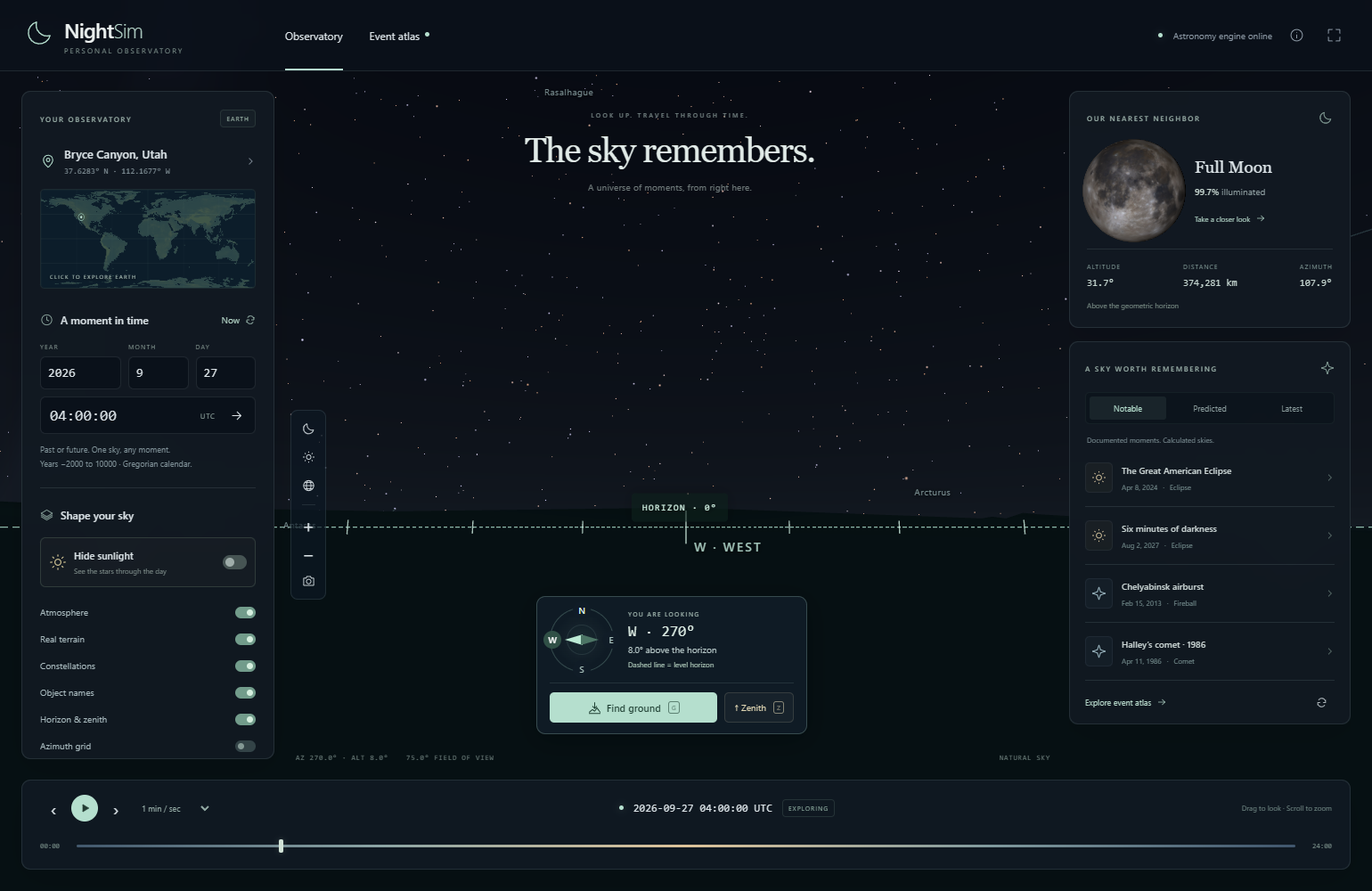
NightSim starts with a place on Earth and a moment in time. Its 41,487 catalog stars, Sun, Moon, and planets are positioned using astronomy calculations. Move through a night, jump to a historical date, or explore a future sky while the Moon’s phase and the view from your location change together.
A low-resolution elevation model gives the view a real landscape. The compass, marked horizon, and zenith pointer help you find your bearings; Find ground brings you back from a close look at the Moon or a deep zoom. Hide sunlight reveals the stars through daytime while preserving the Moon’s illumination.
The event atlas brings together documented eclipses, comet visits, fireballs, and spaceflight history, alongside predicted eclipses and lunar phases. NASA fireball and close-approach feeds refresh while the app is open, and supported comets can request positions from JPL Horizons. Historical satellite incidents load the sky of that moment rather than claiming to reproduce a debris path.
I wanted the experience to be beautiful and clear about what it can establish. The catalog and ephemerides drive the celestial positions; atmospheric color, comet tails, and eclipse glints are illustrative. Remote dates are marked exploratory. NightSim runs in the browser on Cloudflare. Its pass page brings together purchase availability, recovery, and installation instructions for Android and iPhone. The portable Windows edition is a separate development build.
Inside the project
- Past and future dates with location-based celestial positions
- 41,487 catalog stars, the Sun, Moon, and seven planets
- Lunar phases, eclipse views, and a hide-sunlight toggle
- Real elevation data, compass, horizon, and zenith guides
- Documented event presets and refreshing NASA feeds
- Browser observatory with Android and iPhone web-app installation