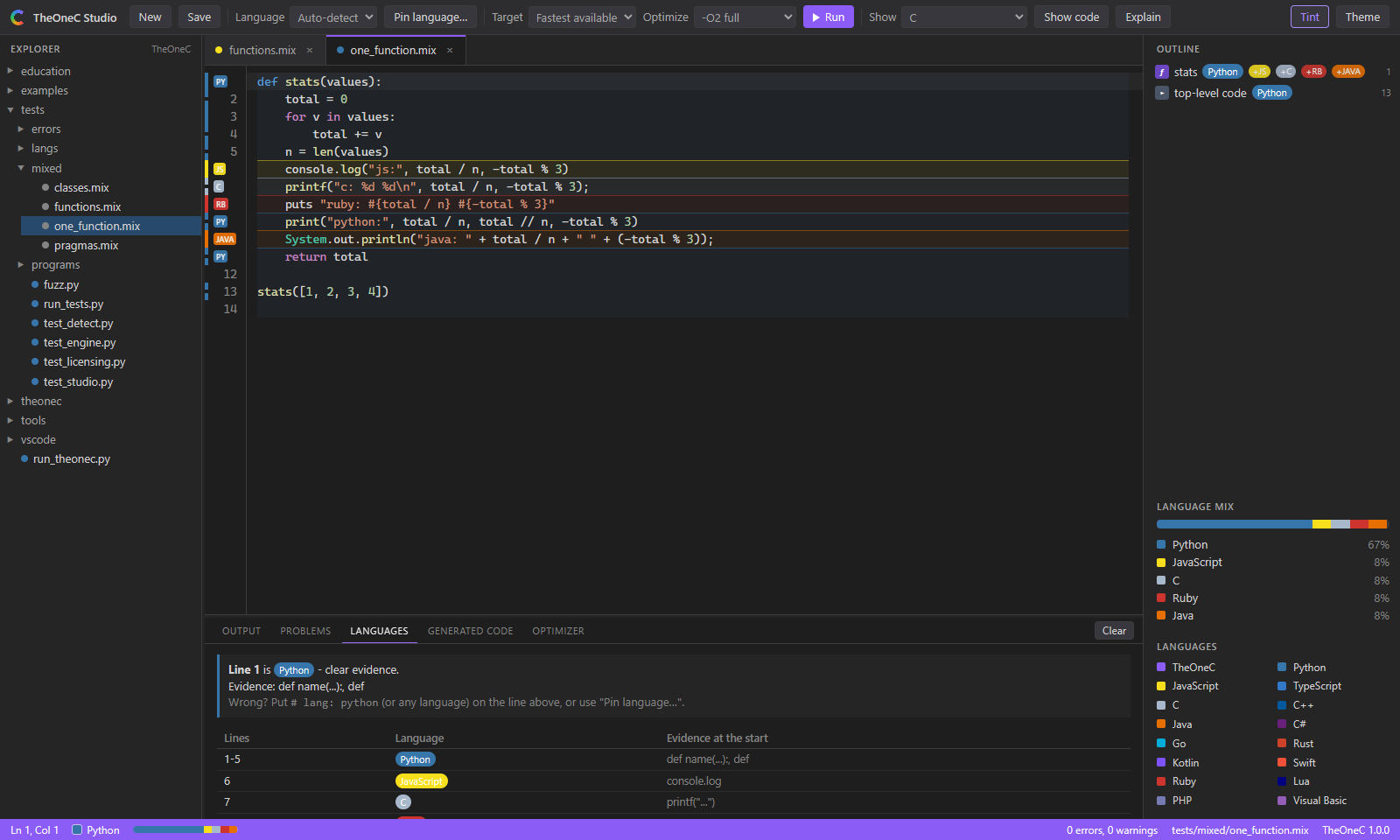
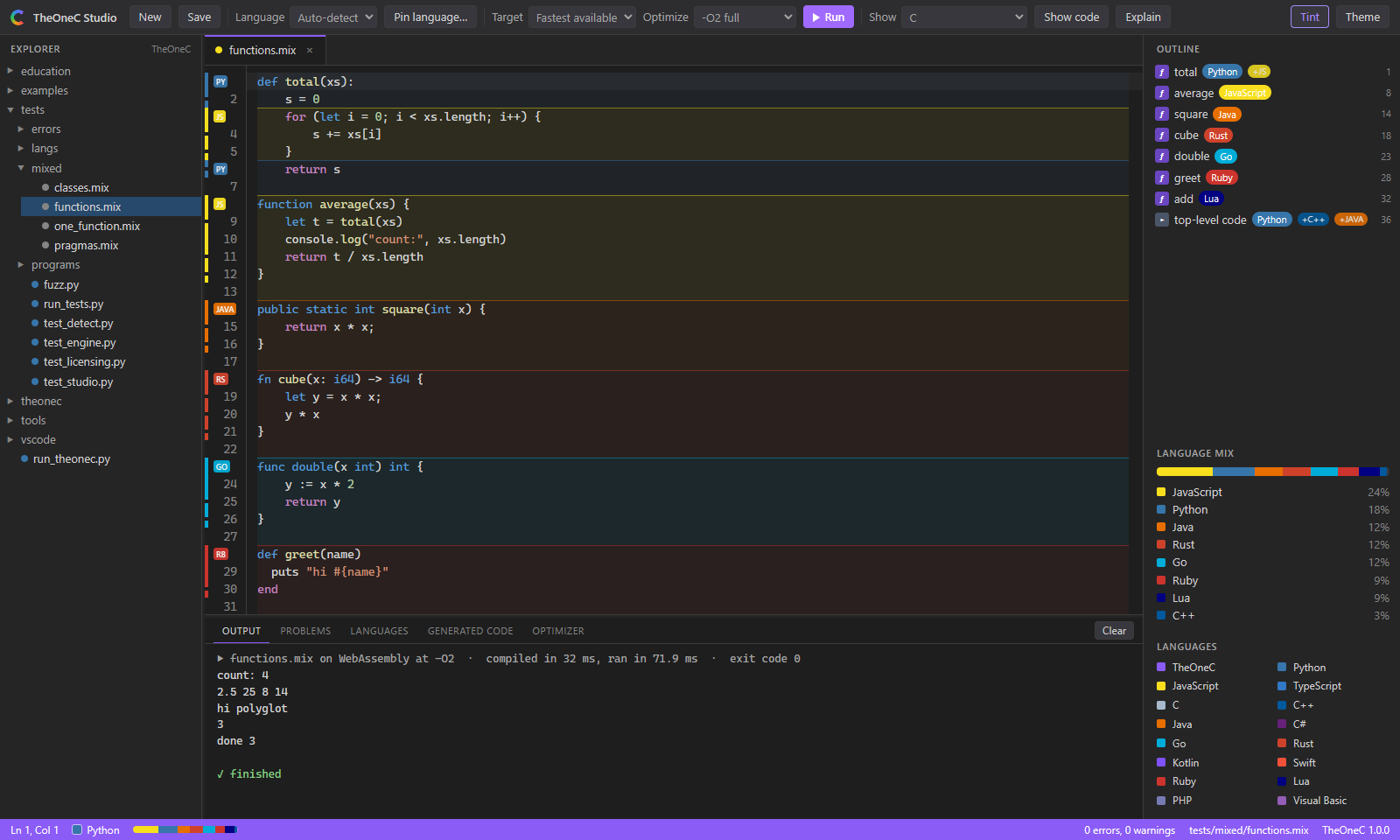
TheOneC started as a question about efficiency: could one compiler take ordinary code and make it fast, without asking the person who wrote it to learn something new? It grew into a bigger question. People move between Python, JavaScript, Java, Rust, and a dozen other languages, and those habits don’t stay in neat boxes. TheOneC accepts that. It reads fifteen popular languages plus its own small one, and lets them meet in the same file, the same function, even on neighboring lines. The name is a nod to one compiler for every language you write.
TheOneC works out the language of every line from clues. A def with a colon suggests Python, console.log suggests JavaScript, and fn with -> i64 suggests Rust. The surrounding code adds context, and a comment such as “lang: ruby” settles a genuinely ambiguous line. Each line keeps its own language’s meaning, so 7 / 2 is 3 on a Java line and 3.5 on a JavaScript line in the same program.
After detection, everything becomes one shared program. A single parser understands every spelling, type inference works out what the code never states, and an optimizer folds constants, inlines small functions, and removes bounds checks it can prove are unnecessary. TheOneC then generates native machine code through a C compiler, WebAssembly for the browser and Node, or plain Python. On an n-body physics benchmark, the native build ran 78 times faster than CPython, and the WebAssembly build 24 times faster.
It now comes in two editions. The VS Code add-on brings the language of every line, hovers with the evidence, problems, an outline, and run and generated-code commands into the editor developers already use. TheOneC Education packages TheOneC Studio, a Visual Studio–style editor that opens in the browser, with six classroom lessons, from why 7 / 2 changes between languages to porting a program one line at a time. Each edition activates with a license key; certificates are checked offline, and source code never leaves the computer.
Quality assurance shaped the whole project. Programs are checked against each language’s own tools (CPython, Node, Visual C++, the JDK, and .NET), and a fuzzer compares random programs across all three engines. The current suite passes 472 program runs, plus error, detection, Studio, license, and engine checks; expected outputs for Go, Rust, Kotlin, Swift, Ruby, Lua, and PHP were checked by hand. TheOneC compiles the common core of each language, not every feature: dictionaries, exceptions, and inheritance come next. Thirteen plain-language chapters explain how it works and why.
Inside the project
- Python, JavaScript, TypeScript, C, C++, Java, C#, Go, Rust, Kotlin, Swift, Ruby, Lua, PHP, Visual Basic, and TheOneC
- Per-line language detection, mixing inside one function, and lang: comments for overrides
- Each language’s own division, remainders, rounding, and print formatting
- Whole-program type inference and an optimizer with inlining and bounds-check elimination
- Native, WebAssembly, and Python back ends
- A VS Code add-on: gutter languages, hovers, Problems, Outline, run, and generated code
- TheOneC Education: Studio, six tested lessons, a teacher guide, and classroom licenses
- Tests against real toolchains, a cross-engine fuzzer, and plain-language documentation